
Winter in Central Russia
Thoughts on the winter season in Russia and how Russians tackle it.
In my twenty plus years in Moscow I remember most Decembers as rainy with temperatures slightly above or below freezing, and this season went as expected: rain and snow changed one another. What was also perfectly normal in this season is the overwhelming darkness. You wake up in the dark, and if you have to go to a day job, dress up, leave your place to the darkness and freeze outside, treading a thick layer of sludge; the pavement is slippery. The skies keep pouring precipitation, yet you cannot even decipher whether it’s drizzle, snow, or rain, and it’s most probably all three at once.
The escalator deepens you into the darkness of the metro. Then you ride a subway car, packed as Russians say “a herring in a barrel,” sweating in your winter garments squeezed between fellow citizens, who’s faces are sullen from a permanent lack of sleep, lack of the sun, lack of joys in lives they have to drag through. Then you push through the crowds of passengers in faintly lit transfer tunnels and exits. It looks surreal, a giant flow of people, pressed one to another, in the dim light, waddling and swaying in unison like penguins on a march. After the metro had ground you, it spits you out into the darkness of a cold and dunk street. Weak, grey, daylight slowly creeps out around nine in the morning, to reveal that the sky is gone; instead it’s a low, solid cloud canvas above, lead-colored, lacking any texture. Room lights are kept on throughout the day. By four in the afternoon, the evening sets in already. Two or tree hours later you leave your workplace, walking in complete darkness again to repeat this pathway on your way back home, or for those in misfortune who have to drive, to spend hours in traffic jams of millions of cars barely moving. Winter turns this city as well as a whole central and western parts of Russia into a dismal place leaving few joys for the eyes.
It reads like a post-apocaliptic scene of doom and gloom, but I admit, this is my biased perception comes out, because I am from the area of the country, where in winter, on any given day, it’s always a clear blue sky and sunny. It is still freezing cold and windy, and for the most part snowless, although an occasional blizzard might visit to dump some snow for a day or two, turning streets into ski slopes and paralyzing city life. But then it leaves, the sky is clear and blue again, bright sun melts the aftermath of the snowfall. And the sky is big there, tall buildings and structures don’t obstruct the view and seascape vistas open from many random locations. In my twenty plus years in central Russia I never got used to its winters and I dread coming of them.
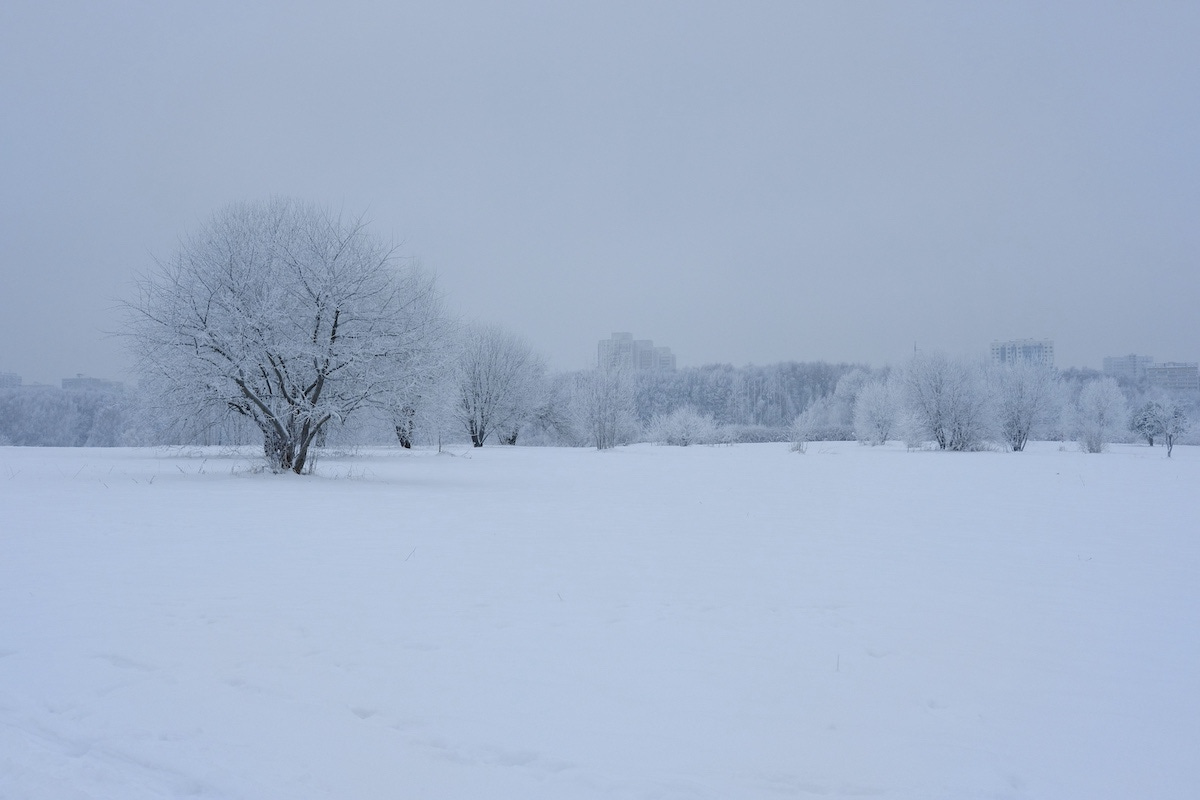
But you see, December inevitably rolls to winter solstice, promising more light to come, marking the beginning of New Year’s festivities. This year, unlike most years I recall, it did not rain on New Year’s night. A wave of arctic air intervened in the final week of December, bringing outside temperatures to steady freezing. It started to snow, the snow did not melt, and the ambience became a lot brighter and lighter. The city put up holiday decorations, lots of them; they do contribute to the jovial atmosphere amid lack of daylight.
Then it was New Year, the most anticipated holiday in Russia, with overnight parties, feasts and fireworks. The following ten days of public holidays everyone spends in their own way. For some festivities are comprised of eating and drinking of what’s left from the holiday table and maybe cooking some more. Some visit their family and meet friends not seen in ages. Some travel, visit events, shows, or just enjoy winter walks in parks or central parts of their cities where a lot of outside activities are organized. Kids go to yolka events, I recently posted a note about those. Shopping malls are crowded these days. Few go to their dachas to enjoy banya and shashlik, if their dacha house is suitable for winter living. Many are doing winter sports if the weather does not disappoint.
January weather did not disappoint this year; it started with snow and more snow. This is a normal course of winter in Moscow and the whole of central Russia; in winter it snows here practically all the time. Snow cover grows, allowing for skiing. Skiing is practically a national sport in Russia, in Moscow in particular. To do skiing one does not need to leave the city. City parks provide plenty of space with trails to be used as ski tracks in winter. Areas like Bitzevsky Park, Izmailovo or Losiniy Ostrov are ideal for cross-country skiing, as all of them are large forests. Moscovites of all ages indulge in skiing; it is not unusual to see elders on a ski track along with families with young children. If you’re into mountain skiing, there are a number of locations within city limits with terrains suitable for downhill skiing: Nagornaya, Krilatskie Holmy. Most of such locations are equipped with lifts and other infrastructure. More choices emerge if you have a car and don’t mind driving some distance to places like Yakhroma, north of Moscow. It’s a full-scale ski resort highly regarded by those who are seriously into winter sports. In Moscow public transportation, in winter, you often meet people carrying skies or snowboards.
Kids enjoy sleds using any elevation that can be found in a relatively flat place like Moscow. Alternatives to sleds are vatrushka (inflatable snow tube) and ledyanka (a flat piece of plastic, a snow slider mat).
Another winter passion of many locals is ice skating, another truly people’s sport. In many families you’ll find ice skates in the closet, waiting for the season. Ice skating rinks appear all over Moscow, in every residential area there is one. They are free to use, have street lights for night use, oftentimes provide ice skate rental service, and some other infrastructure. My apartment overlooks a sports field next to a local school. Workers drag long hoses start pumping water onto the field grounds and in days it becomes an ice skating rink. Such skating rinks are many, scattered across this mammoth city, on school premises, or between apartment buildings, seemingly random locations.
If you are like locals and refuse to succumb to the winter blues, winter swigs by, being barely noticeable. It takes a lot of strength and resilience in the character to find joys, reasons and ways to celebrate in the middle of the cold and dark, in whatever meaning both terms might be used. This resilience is definitely a part of the Russian character, which is passed from previous generations only to be reinforced by the following generation. It’s a national courage to find good sense for simple joys, to celebrate and carry on despite outside circumstances.
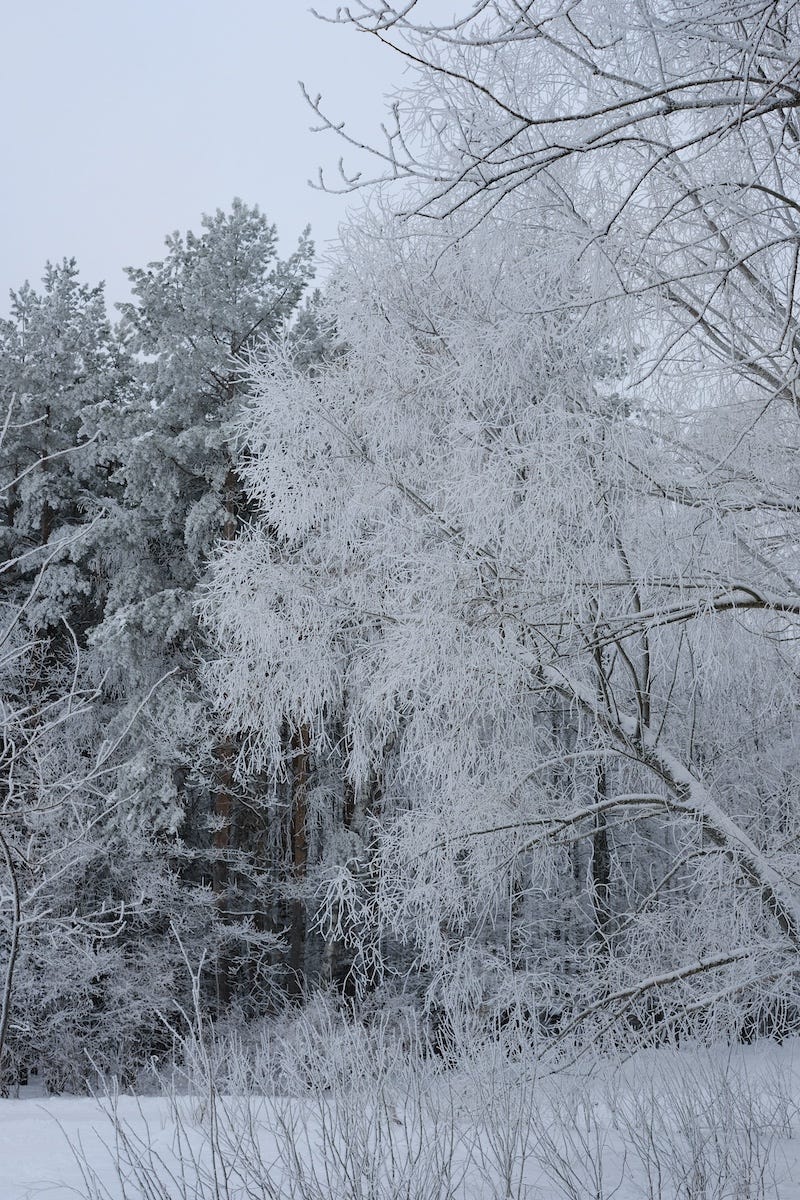
I love taking pictures simply to catch the moments of beauty in the place which I subjectively do not consider scenic or visually compelling (I mean Moscow), and in winter frequently head out after a good snow to photograph the snowy cityscapes with the freshly fallen snow still white and not walked over. I directed a camera at something and a woman interrupted her stroll, turning to me and saying that her friend from the other part of Moscow had sent her nice pictures of the ice frost, and it was beautiful. She went on telling more about the beauty around, as if it was not obvious.
A passerby, a stranger, pointed at a tree next to the one I was taking a picture of. “It’s more interesting there,” he said. “See, there is a thrush bird on the tree, they forage on rowan berries in winter” He was right, the bird was there, but sure enough, the moment I pointed the camera, it took off from the branch. I know those birds; they are regular Moscow species. They are funny looking; in summer you frequently spot them on the ground, making quick short runs and curiously or cautiously sticking heads out of the grass.
Later I was in the elevator with a bunch of neighbors and an elderly woman turned to a teenager next to her with a question: “What sport do you play?” I often meet a bunch of youngsters dragging long rolling carts from a nearby sports facility and this guy had one of those. Apparently, it was sports equipment, but I had no idea which, so I turned to listen to what he’d answer. “It’s fencing,” the guy replied. I’ve never seen this lady before, but we looked at each other, and I said to her: “You just solved a mystery for me about what’s in those carts” She giggled and replied: “We were wondering about that too.”

Dmitry - Very nice.
The vignettes of the human interactions was heart warming, and much needed here this morning. Thank you.
I get the feeling about the grey skies. We've got the Lake Ontario weather effect, but at least it's the better side where it's only Moscow Gray Skies with a bit of snow a lot of the time. Poor Buffalo on the other side of the lake gets hammered with meters of snow. Sometimes though we get a strong artic blast and the skies turn Parrish Blue (but we have to wear 4 or 5 layers and special boots to stay out side for long). Are there these sorts of days in Moscow, and do the parks get crowded like a penguin flock with all the faces tracking the sun? Here is most of the people live in stand-alone houses, and most put Christmas lights up in November and leave them till Early April, just to get more colour. In Tokyo (and Hong Kong, though it isn't gloomy) people like to stroll in the commercial centers to appreciate the light shows. Is there a similar effort in Moscow? Other cities?
Thank the god(s) though for the snow we do get. My American friends don't get my love for it, but to have the snow amplify the sunlight on those gray days makes all the difference.